


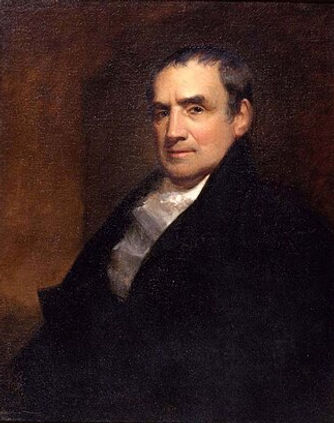
Mathew Carey
Mathew Carey (1760-1839) was born on January 28, 1760, in Dublin, Ireland. His parents were Christopher and Mary Sherridan Carey. His father was a baker, who was contracted to supply breadstuffs for the navy. Although his father disapproved of him entering into the printing profession, Mathew Carey would end up becoming an apprentice printer and bookseller for a local publisher, by the name of Thomas McDonnell, at the age of fifteen. Later, Carey would end up writing articles for McDonnel’s Hiberian Journal, which was known for its anti-English and pro-American views. Carey’s vocal criticisms of Britain’s interventions in Ireland eventually led to him exiling himself from his homeland out fear of repercussion. In 1781, Carey escaped to France where he became acquainted with Benjamin Franklin. Franklin, who was serving as the American ambassador to France during the War of Independence, was so impressed with Carey’s pro-American reputation, that he hired Carey to work at his printery. In the following year, Carey returned to Ireland to serve a brief stint as the editor of the inaugural Irish nationalist newspaper, the Volunteers Journal. Aggravated by the newspaper’s hostility towards the crown, the Irish government eventually ordered Carey’s arrest. In order to avoid imprisonment, Carey emigrated to Philadelphia in 1784. As legend has it, Carey snuck abroad the departing ship, The America, disguised as a woman.
Shortly after his arrival in the New World, Carey would establish a printing house with the help of $400 charity from Marquis de Lafayette, a French general who served in the Revolutionary War, whom Carey befriended during his time in France. Over the next several years, Carey founded several magazines and newspapers, including the Pennsylvania Evening Herald in January of 1785, the Columbian Magazine in October of 1786, and the more popular American Museum in January of 1787. Many protectionist articles written by the likes of William Barton and Tench Coxe would feature in these publications. The American Museum would eventually cease in 1792, resulting from an increase in the price of postage for magazines. This caused Carey to enter into the publication of books. The most successful of these early publications was what became known as “the Carey Bible”, which was in publication from 1790 to 1821, and represented the first quarto Bible printed in the United States. Carey’s first major literary work, The Olive Branch, or Faults on Both Sides, would appear in 1814. This work represented a plea for both Federalists and Democratic-Republicans to reconcile their partizan differences in the spirit of patriotism.
Mathew Carey’s involvement in the American Protectionist movement would begin around 1819. Prior to this, Carey, by his own admission, “knew very little, scarcely any thing of political economy”, explaining that he “did not recollect that [he] had ever written a page on it – nor had [he] read much.” Carey, however, quickly became the effective leader of the movement. Carey’s first work, Addresses of the Philadelphia Society for the Promotion of National Industry, appeared in 1819. As the names suggests, this was a series of addresses written by Carey for the Philadelphia Society for the Promotion of National Industry, which Carey helped found earlier that year, with roughly ten other individuals, including Tench Coxe, Samuel Jackson, and John Melish. In 1820, Carey produced The New Olive Branch, which sought to establish the “complete identity of interest between agriculture, manufacturing, and commerce,” a theme which was later picked up by his Son, Henry Charles Carey. In 1822, Carey would then produce his Essays on Political Economy which served as a work which incorporated The New Olive Branch, his earlier Addresses, and several other essays, into one comprehensive volume. In the same year, Carey would also commence writing a series of essays entitled Hamilton, which Carey penned under the pseudonym ‘Hamilton’, a pseudonym that Carey adopted frequently. His Hamilton essays when through twelve series between 1822 and 1826, and comprised 63 essays.
In 1825, Mathew Carey would retire from his bookselling business and would hand the business over to two of his sons, Henry Carey and Edward L. Carey. A year prior to his retirement, Mathew Carey made sure to return $400 to Lafayette, who had returned to the United States that year in financial ruin. Carey would continue writing on various topics and would also engage in various charity work into his retirement. He would later pass away on September 16, 1839, after a brief illness. He was buried in St. Mary’s Roman Catholic Church Cemetery in Philadelphia.